Graham Crowley:
Artist of the Month

I Paint Shadows, Installation view, Walker Art Gallery, Liverpool. Photo Pete Carr, National Museums Liverpool, 2025
ARTIST OF THE MONTH AUGUST 2026:
Graham Crowley, selected and interviewed by Paul Newman for Contemporary British Painting.
“I paint shadows. I’m intrigued by luminosity in painting. This is the driving force behind LIGHT INDUSTRY*. I’ve always been fascinated by those of Manet. The way in which the image and the painting (as its own object) can be seen simultaneously – fused together as a single luminous entity. This remarkable duality is one of paintings defining characteristics.
I discovered my subject matter during a visit to Andy Tiernan Classics, a classic motorcycle dealer in Framlingham, Suffolk. It’s part workshop and part counter cultural ‘museum’. What I found enthralling about the place was the light; a diffused, dusty kind of light that emanated from a grubby skylight. I thought this significant because I regard light as synonymous with life and luminosity as painting’s equivalent…“
*Extract from a statement first that appeared to accompany LIGHT INDUSTRY which won the first prize in the John Moores Painting Prize in 2023.

Light Industry, oil on canvas, 152 x 178cm, 2022. The Walker Art Gallery Liverpool
CBP: Light Industry, winner of the John Moors Painting Prize in 2023 feels like a statement piece from this body of work. It’s based on a mechanical bike workshop and alludes to the artist’s studio, twinning your passions as a painter and motorbikes. There’s a sense of weary romanticism with a halcyon, radiant energy in the loosely painted, immersive environment of yellow and Paynes grey. Can you talk about the significance of this painting to you and your practice?
GC: Yes. Light Industry was a synthesis of my longstanding preoccupation with luminosity and thought. I not only regard it as a ‘statement piece’ but a personal revelation; that light, shadow and reflection, although ubiquitous are all utterly intangible; delivering a near perfect metaphor for painting. This is because I regard painting as a discourse. One
that’s seeded in my abiding preoccupation with meaning and mind. Or more correctly the philosophy of mind.

Flower Arranging 6, oil on canvas, 183 x 152cm, 1998
For as long as I can remember, one of the defining characteristics of my practice has been change. Multiple changes of appearance, manifested in a variety of genre and pictorial strategies but not in overall intention and behaviour which has been self-disrupting and counter intuitive in order to defeat any ‘product identity’. This was probably epitomised by my monochromatic, glazed impasto flower paintings which I began making almost 40 years ago.

Light Industry 4, oil on canvas, 70 x 90cm, 2026
CBP: Light Industry is indicative of your work. There’s an intuitive precision that lands on a sweet spot between fluid painterly gesture as abstraction and description and illusion.
Can you discuss this notion, and how you draw with paint into your grounds? What source imagery do you work from? And are these the ‘one take’ paintings they appear to be?
GC: Absolutely. In Light Industry and my current paintings generally, I’m concerned with the duality between the painting as ‘its own object’ and the image. I regard this duality as one of painting’s defining characteristics. The intrinsically abstract nature of paint’s materiality combined with the intention to render. I don’t recognise figurative versus abstract dichotomy. I regard it as a convenient and rather intellectually lazy form of labelling.
Another essential characteristic that epitomises painting – one that differentiates it from illustration – is its indeterminacy.

Dark Arc 18, oil on pegboard, 18 x 23cm, 2025
When it comes to method; I apply Winsor & Newton’s Original Liquin over a dry ground, invariably cadmium lemon, which I’ve discovered gives the paintings an optical ‘instability’ that lends the work an apparent luminosity. I work quickly applying Paynes grey in a manner that’s described as ‘wet-into-wet’.
Whilst working I rely upon memory, I tend to paint that which I’m familiar with. I’ll also refer to previous paintings. I habitually paint and repaint the same or similar images, which are occasionally augmented by low resolution photos which I then discard. My recent subject matter has predominantly been workshops, what I describe as ‘sites of creativity’. But the content of my paintings is light and shadow.
However, strictly speaking it’s only shadows, as I believe light can only be inferred but never depicted. These are essentially one-shot paintings. Although I occasionally make some small adjustments intended to reinforce the duality that I described earlier

Light Industry 2, oil on board, 33 x 44cm, 2025

A Love of Many Things 4, oil on canvas, 144 x 137cm, 2020
CBP: One of the many influences you have referred to is Samuel Palmer, the C19th painter whose exquisitely burnished landscapes sometimes have a sense of gloaming, associated with twilight. Your paintings are also luminous and ethereal through an economical painting strategy of duotone utilising a single-coloured ground. You also have declared you paint shadows. Can you say something about your approach to evoking light and shadows and in your painting?
GC: Over the years I’ve embraced many influences. But you’re right in singling out Samuel Palmer. Particularly his early work which I’ve found massively influential. Not simply because of its primary reliance upon tonal painting but because of its ‘other worldly’ quality.
Something I think of as being between ‘waking and dreaming’. Eternal. One painting which has stayed with me is Early Morning dated 1825 which in retrospect I believe I was unwittingly referencing when I was painting my A Love of Many Things paintings a couple of years ago. Anyone familiar with Palmer’s work will be aware of his restlessness and
perpetual experimentation. I also identify with his temperament; that of constant self-doubt and general unease. Palmer was an admirer and close friend of William Blake, who remains one of British paintings seminal figures, lauded for his radicalism and vision which still resonate

Kitchen Life, oil on canvas, 152.5 x 122cm, 1981
CBP: Kitchen Life 1981, part of your early career interior surrealist works reminds me of one of my favourite paintings in the Birmingham Museum and Art Gallery Trust collection, Nightwork is about to Commence by Birmingham Surrealist Emmy Bridgwater, 1940-43, in its turbulent shape shifting laundry subject and melancholy atmosphere. The painting is unfortunately not on display at the moment. What conversation would 1981’s Kitchen Life have with a recent interior painting of yours such as ‘Room 601-8’, 2024 (There is a similar time gap in the production of these three paintings.)
GC: I understand why you mention Emmy Bridgwater’s 1940/43 painting Nightwork ls About To Commence when looking at Kitchen Life painted in 1981. There’s a striking resemblance and I have to acknowledge a passing acquaintance – but only through reproduction and then not until about 1990, that’s a decade after I’d painted Kitchen Life.

Room 601-8, oil on canvas, 110 x 132cm, 2024
My early anthropomorphic still lives and domestic interiors were a response to the rhetoric and ‘attitude’ of what was regarded in the late 70s and early 80s as ‘ambitious’ or ‘serious’ painting. My paintings at this time were a rather clumsy reaction against what by then had become post-modern conventions and cliches; the appropriation of image and sign along with some ponderous or specious text. The abiding lesson of post-modernism was that although originality may now be an impossibility, synthesis might provide a way forward.
The 80s were a time when painting that reflected the concerns and sensibility of painters like Bridgwater, Burra and Nash rather than Americans like Pollock or Still were dismissed as trivial, being ‘utterly English’.
However, the late paintings of Guston, which owed a considerable debt to Robert Crumb, were massively influential at that time. They appeared to show a way forward; through synthesis.

Ruin 1, oil on board, 13 x 15cm, 2026
CBP: You have just curated the latest version of the group painting show Silent Disco. Can you talk about its concept and something about the latest iteration and Silent Disco’s dialogue with painting today?
GC: I’ve curated numerous exhibitions. But there is an arc of three recent projects that I think worthy of mention. First: The Tyranny Of Ambition in Ireland in 2022 at the Highlanes Gallery in Drogheda. An exhibition of ten painters from the UK and ten from Ireland that presented a platform for diverse, intelligent and insightful new painting. It was also a project that was intended to differentiate between false ambition and emergent, alternative core values. A celebrity-free space. A reset. These are values that seem to have emerged over the last decade, whilst I was curating the Silent Disco project. The series of Silent Disco shows were intended to present painting as a discourse rather than a commodity. Painting as a vibrant, diverse contemporary sub-culture. What is referred to as post-conceptual painting.
It became a demonstration of painting’s reach and diversity, reflecting an emergent ‘community of practice’ distinct from the art market. A movement that embraces curiosity, diversity, reflection and mutual respect and at the risk of sounding daft – kindness. Rather than celebrity, entitlement and wealth. Also substituting hackneyed aesthetic judgements with meaningful observation and insight. Thinking rather than opining. Which is why Rob Dunt and I started making the ‘walk and talk’ videos of the shows.
Our films are intended to demonstrate a jargon free, informative and (dare I say) entertaining insight into how painting or creativity generally can be discussed without resorting to approval or disapproval; epitomised by the throwaway ‘I like it’ or ‘I don’t like it’, or worse still art-speak. Something else became evident during our filming; Rob asked me how I chose the work for inclusion in the various Silent Disco exhibitions. I told Rob that I didn’t choose the work, I chose the people. I sought intention.

Break in the Clouds, oil on canvas, 90 x 120cm, 2021
The now redundant Turner Prize which was often touted as ‘conceptual art versus painting’ has always promoted a false dichotomy which was spun by journalists in order to grab the attention of the inattentive. It was an entirely false dichotomy because painting is and always has been – the most profound, complex and exquisite form of conceptual visual art ever.
On a personal note, Domo Baal and I co-curated my recent solo show at The Walker Art Gallery. An exhibition that featured about a dozen duotone (cadmium lemon and Paynes grey) paintings of varying sizes hung on grey walls accompanied by a floor to ceiling poem titled Cadmium Lemon by the eminent American poet (now UK resident) Tamar Yoseloff. Our intention was that the show should have an element of installation as well as being an exhibition of paintings. One that almost 30,000 people visited.
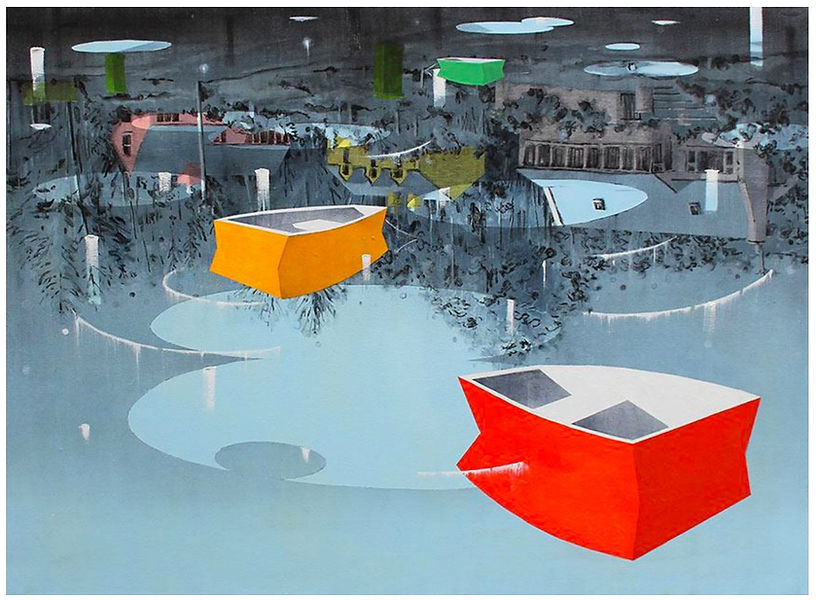
Blue Drift 4, oil on canvas, 92 x 122cm, 2015

Graham Crowley: painter, writer, curator & teacher. Born in 1950 in Romford, Essex. Attended St Martin’s College of Art 1968-1972.
Subsequently attended the Royal College of Art 1972-1975.
Became Artist-in-Residence to Oxford University & Visiting Fellow at St Edmund’s Hall 1982-1983. Then Senior Fellow at Cardiff Art School 1986-1989.
Exhibited widely in the UK, Europe, USA, Canada & Asia. Work held in public and private collections in UK, Europe, North America, Australia, New Zealand and
Taiwan.
Visiting lecturer at numerous art schools in UK, Ireland, USA and Canada. Head of Fine Art, City & Guilds of London Art School 1986-1998 and then Professor of Painting at the Royal College of Art 1998-2006.
Winner of the John Moores Painting Prize 2023.
https://www.grahamcrowley.co.uk
Silent Disco 2026: Graham Crowley & Justin Hibbs on Britain’s Most Exciting Painting Show.
https://www.contemporarybritishpainting.com/graham-crowley-artist-of-the-month/